Smart Design
The six-seat Compressed Air Vehicle zips through urban streets and highways. It is roomy, adaptable, convivial, and comfortable. Its innovative swivel front passenger seat makes it possible to turn around to face rear seat passengers. It’s modular design and assembly allows for both commercial and private uses.
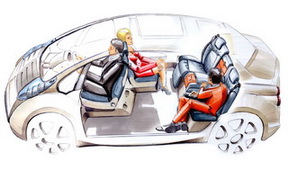

Body: Built with fiberglass and injected foam, the Compressed Air Vehicle body competes with only a few other cars on the market today. Fiberglass is safer, easier to repair, and does not rust. Although many manufacturers choose metal sheet for cost considerations, we choose fiberglass for over-time efficiency and reliability.
Chassis: Based on the manufacturer’s aeronautics experience, the chassis is composed of aluminum rods and is impact-resistant and light. Glued in the same way as air craft, they allow for quick assembly and a more secure join than with welding.
Electrical System: Using a radio transmission system, each electrical component receives signals with a microprocessor. This makes it possible to use only one signal cable for the entire car instead of wiring each component separately. Headlights, dashboard, and more, are all connected via wiring harness for both ease of installation and repair. In addition, the entire system becomes an anti-theft alarm as soon as you remove your key from the car.
Communication Console: Instead of the usual speedometer found in most cars, the Compressed Air Vehicle employs a dashboard computer which screen displays the speed and engine revolutions. This system allows for many options that include Internet connection, GPS, custom programs for delivery people, traffic information, and emergency systems, among others.
Transmission: The horizontally opposed engine is rear-mounted, driving the rear wheels (to eliminate friction losses caused by transmitting power to steered wheels) via a multi-function “moto-alternator” and a gearbox needing only two or three ratios.
Our Mission: To bring zero pollution motoring at any speed, for any distance, to the largest number of motorists possible and, in doing so, significantly improve the quality of the air we breathe and reduce our collective carbon footprint.
MDI and the Compressed Air Vehicle
Media inquiries about the MDI and its compressed air vehicles can be directed to Media Relations